Contribution to localtunnel, a JavaScript Library
The Discovery
Thank you GitHub!!!
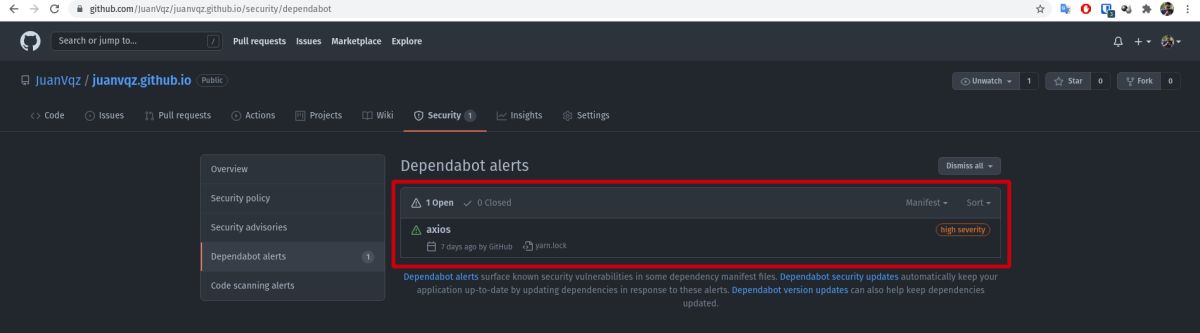
GitHub reported a security vulnerability 🙈 in my juanvqz.github.io repository which is related to axios.
Axios, Promise based HTTP client for the browser and node.js
The Investigation
Which was curious because as far as I knew I wasn’t using axios in my blog. So I set out to update the dependencies — how hard could it be to run yarn upgrade and then see if everything still works?
1
yarn upgrade
After running the command and reviewing the git diff, axios was still outdated.
I checked yarn.lock, which contains the exact versions of the package.json dependencies, and realized something important: axios wasn’t a direct dependency of my blog.
It was a dependency of a dependency.
The Dependency Tree
Tracing through the dependency tree, I found:
1
2
3
juanvqz.github.io (my blog)
  └─ localtunnel (dev dependency)
      └─ axios (security vulnerability)
localtunnel exposes your localhost to the world for testing and sharing. No need to configure DNS or deploy for others to test your changes.
So my blog didn’t use axios directly — it was brought in by localtunnel.
The Solution
Running yarn upgrade only updates direct dependencies. To update second-level (transitive) dependencies, you need a different approach.
Option 1: Force Update
1
yarn upgrade localtunnel --latest
This forces localtunnel to update to its latest version, which should include the updated axios.
Option 2: Fix at the Source
The real fix is in the localtunnel repository itself. I opened a Pull Request to update axios in the localtunnel package.json.
The PR already has two comments supporting the inclusion of the solution.
What I Learned
Dependency trees are deeper than you think — Security vulnerabilities can hide in third- or fourth-level dependencies. You need tools like Dependabot to surface them
Transitive dependencies matter — Even if you don’t use a library directly, you’re affected by its vulnerabilities if your dependencies use it
yarn upgradehas limits — It updates direct dependencies, not transitive ones. To update deep dependencies, you need different strategiesFix at the source when possible — While you can work around transitive dependency issues locally, the best fix is to update the package that introduces the vulnerable dependency
Contributing to your dependencies — When you find a vulnerability or bug in a dependency you use, contribute a fix. It helps the whole ecosystem
Security is everyone’s responsibility — GitHub’s Dependabot found this automatically, but we still need to act on it. Security tools are useless without human follow-through
Update on the Pull Request
I’ll update this article later with the Pull Request status. As of now, it’s pending review and has community support.
Fun Fact
Yarn doesn’t have a native command to update second-level dependencies (at least I couldn’t find one). If you know the command, I’d appreciate it if you share it.
Tools for Managing Transitive Dependencies
If you’re dealing with similar issues, here are some tools that can help:
- npm-check-updates — Checks for package updates
- npm audit — Scans for vulnerabilities
- Snyk — Security scanning for dependencies
- Dependabot — Automated dependency updates (what found this issue)
Remember: Your dependencies are part of your security perimeter. Treat them with the same care as your own code.